Get Your Free Quote
Step 1 of 2 · takes 30 seconds
Yes, You Need a Permit
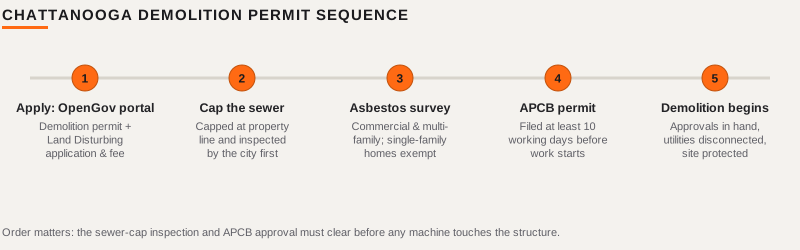
If you're demolishing a structure inside the City of Chattanooga — a house, a commercial building, in most cases even a detached garage — you need a demolition permit before work starts. Demolishing without one risks stop-work orders, fines, and problems when you later try to permit new construction or sell the lot. The permit itself isn't the hard part; the sequence of approvals around it is what trips people up.
Step 1: Apply Through the City's OpenGov Portal
City of Chattanooga demolition permit applications go through the city's OpenGov online portal — you create a free account, file the demolition application for the property, and pay the fee. Alongside the demolition application, the city requires a Land Disturbing Application whenever footings or foundations will be removed or heavy equipment will be used, including a site plan showing property contours and silt-fencing locations. Development permitting is administered by the city's Land Development Office ((423) 643-5802).
Residential and commercial demolitions run through the same portal, with commercial projects carrying heavier documentation (asbestos survey reports in particular).
Step 2: Cap the Sewer — and Get It Inspected
This is the step that surprises almost everyone. Per the city's permit requirements, "demolition shall not begin until sewer is properly capped at the property line and inspected by the City of Chattanooga's Inspection Division." It exists for a good reason: an open lateral on a cleared lot lets groundwater and debris into the public sewer system.
Practically, this means excavating at the property line, physically capping the lateral, calling in the inspection, and getting the approval before an excavator touches the structure. It requires digging equipment and scheduling lead time, which is why it's the classic project-stopper for owners trying to run their own permit. On our jobs it's simply a line item handled in week one.
Step 3: The Asbestos Survey — Who Actually Needs One
Before demolition of commercial buildings, institutional buildings, and multi-family dwellings, the structure must be surveyed for asbestos-containing materials — an inspection, sampling, and lab testing conducted by an individual or company certified by the State of Tennessee.
The single-family exemption: the Air Pollution Control Bureau states that demolition of a single-family dwelling does not require an asbestos survey or Bureau permit, provided the building has not been used in the past for an institution, office, or commercial purpose; the city's permit instructions describe the exemption as one single-family dwelling demolition per fiscal year. If you're not sure which side of the exemption you're on, call the Bureau at (423) 643-5970 — don't guess.
Exempt or not, pre-1980s buildings routinely contain asbestos in flooring, siding, roofing, ceiling texture, and pipe insulation, and demolition turns it into airborne dust unless it's removed first by a licensed abatement contractor. Testing suspect materials before disturbance is the safe practice on any structure. If a survey is positive, licensed abatement is scheduled before demolition — added cost and time, but non-negotiable and far cheaper than the contaminated alternative. Surveys and abatement are coordinated on every job; see how it fits a full teardown on the house demolition page.
Step 4: Air Pollution Control Bureau Permit
For every demolition that doesn't qualify for the single-family exemption, the Chattanooga–Hamilton County Air Pollution Control Bureau requires a permit — tied to the asbestos survey and federal air-quality (NESHAP) requirements — filed at least 10 working days before work starts. The city won't let the project proceed without the Bureau's final approval. This is the approval layer most DIY permit-seekers have never heard of, and even for an exempt house, the rest of the process (OpenGov application, sewer cap) still fully applies.
City vs. County vs. Georgia: Whose Rules Apply?
Where the structure sits determines the process:
- Inside Chattanooga city limits: everything on this page — OpenGov application, sewer-cap inspection, APCB.
- Unincorporated Hamilton County or other municipalities (East Ridge, Red Bank, Soddy-Daisy, Signal Mountain, Collegedale): permitting runs through the county or that city's own building office, with requirements that rhyme with Chattanooga's but differ in details. Air-quality rules through the APCB apply county-wide.
- North Georgia (Ringgold, Fort Oglethorpe, Catoosa/Walker Counties): Georgia state and county rules apply — a different permit office and different notification path entirely.
The correct permits are pulled for whichever jurisdiction your property is in.
One More Wrinkle: Historic Districts
If the structure is in one of Chattanooga's four locally designated historic districts — St. Elmo, Fort Wood, Ferger Place, and Battery Place — demolition requires review by the Chattanooga Historic Zoning Commission and a Certificate of Appropriateness before work can proceed; the Commission must approve or deny after a public hearing, within 30 days of proper review. That's a public-review process with its own timeline, and it belongs at the very front of your project plan. Historic-district status gets identified during quoting so it never ambushes your schedule.
What Permits Cost and How Long They Take
- City permit fees (per the city's published schedule): $200 for residential structures up to 4 units; $350 for non-residential buildings up to 35 ft and under 10,000 sq ft, and for apartments up to 3 stories; $500 for non-residential over 10,000 sq ft.
- Beyond the fee: the sewer-cap excavation and inspection, and any required asbestos survey, are separate costs that vary by site — they're usually a bigger line than the permit fee itself.
- Timeline: for a standard residential demo, budget 1–3 weeks from application to released permit, driven mostly by sewer-cap inspection and survey scheduling; non-exempt projects must also build in the APCB's 10-working-day minimum notice. Historic-district review or abatement adds more.
When a demolition is quoted, permit fees and this entire timeline are built into the number and the schedule — no surprise invoice for "the paperwork."
Frequently Asked Questions
Do I need a permit to tear down my house in Chattanooga?
Yes. A city demolition permit (via the OpenGov portal) is required, along with a sewer-cap inspection before work begins. Commercial and multi-family projects also need an asbestos survey and Air Pollution Control Bureau permit; a single-family home is generally exempt from the APCB step. All of it is pulled for our clients.
How much do demolition permits cost?
The city's published demolition permit fee is $200 for residential structures (up to 4 units) and $350–$500 for larger or non-residential buildings. The bigger costs sit around the permit: sewer-cap excavation and inspection, and an asbestos survey where one is required. Those are all included in our demolition quotes.
How long does it take to get a demolition permit in Chattanooga?
Typically 1–3 weeks for a standard house, with the sewer-cap inspection setting the pace; commercial projects add the asbestos survey and the APCB's minimum 10-working-day notice. Historic-district review or required abatement extends that. Every step runs in parallel to compress it.
Does the sewer really have to be capped before demolition?
Yes — capped at the property line and inspected by the city's Inspection Division before demolition begins. It's enforced, it requires excavation equipment, and it's the single most common thing that stalls owner-managed demo projects.
Can I pull a demolition permit myself as a homeowner?
Often you can — and if you're demolishing your own single-family house, you may be exempt from the APCB survey-and-permit step. Whether you should is another question: you'll still be coordinating the sewer cap, the inspection, and utility disconnects yourself. Most people who price out their own time hand it to a contractor.
What happens if someone demolishes without a permit?
Stop-work orders and fines in the immediate term — and longer-term problems that hurt more: trouble permitting new construction on the lot, complications at sale when the demolition can't be documented, and full exposure if asbestos went into the air or the sewer was left uncapped. It's the worst money anyone saves.